 |
Geo-Textile Testing
a) Tensile Strength Tests For Non-Woven Geotextiles b) CBR Punctual Test For Non-Woven Geotextile c) Opening Size Apparent Test For Non Woven Geotextile d) 50mm Vertical Permeability Test
(a) TENSILE STRENGTH TESTS FOR NON-WOVEN GEOTEXTILES
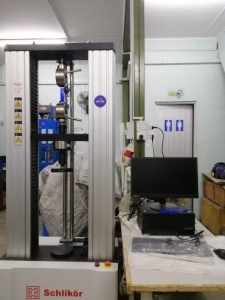
Watima Testing also perform Tensile strength tests for non-woven geotextiles to evaluate breaking load, elongation,
and load-strain behavior to ensure material integrity and field performance.
Testing prevents grip slippage and edge-tearing, and accurately captures the material's structural response.
Nonwoven geotextiles are flat textile structures made from synthetic fibers, assembled through advanced needle-punching or
thermal bonding processes. Known for their versatility and reliability, these materials are widely used in various
applications to provide separation, filtration, and protection functions. Nonwoven geotextiles are also fundamental
components in composite systems, combining seamlessly with other geosynthetics to enhance overall performance in complex projects
(b) CBR PUNCTUAL TEST FOR NON-WOVEN GEOTEXTILE
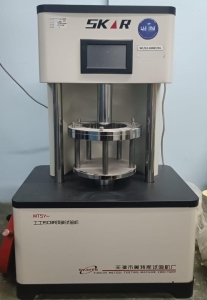
The CBR (California Bearing Ratio) puncture test measures the multi-axial puncture strength of geotextiles.
For non-woven geotextiles, this test is crucial for assessing how well the fabric can resist damage from sharp stones,
aggregates, and construction traffic without tearing or puncturing.
(c) OPENING SIZE APPARENT TEST FOR NON WOVEN GEOTEXTILE
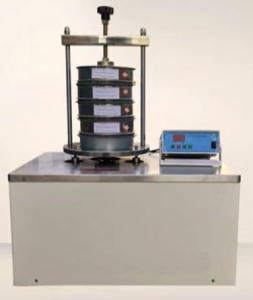
AOS (Apparent Opening Size) is a straightforward test. During the test, spherical, solid glass beads are dry sieved through a geotextile for a specified time and at a specified frequency of vibration. The amount of beads retained by the geotextile sample is then measured. The test is carried out on a range of sizes of glass beads. The apparent opening size is the pore size, measured in millimeters, at which 90% of the glass beads are retained on and within the fabric.
(d) 50MM VERTICAL PERMEABILITY TEST
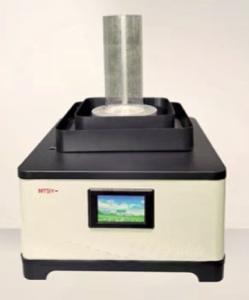
A 50mm vertical permeability test typically refers to a laboratory evaluation measuring how easily water flows perpendicularly (vertically) through a 50mm diameter specimen. This is commonly used in geotechnical engineering to evaluate fine-grained soils or geotextiles using a constant or falling hydraulic head.
|
